How blockchain will finally convert you: Control over your own data

In the past few years, blockchain has developed an unrivaled reputation as the next big thing for the decentralized internet. Startups have absorbed billions of dollars from traditional funding and token sales to develop software and proof-of-concepts that employ blockchain to fix many of the problems that riddle centralized online services.

But will blockchain tech see mainstream adoption?

Blockchain promises it can protect us against DDoS attacks and data tampering, prevent voter fraud, speed up transactions, reduce costs, and enforce transparency and auditability. And these are characteristics every IT expert and software developer can appreciate, but they’re also characteristics the average user takes for granted. Why should a user abandon established cloud services for unknown alternatives that provide similar features on the surface? As long as Skype works fine 99 percent of the time, why should I switch to a blockchain-based alternative?

Blockchain needs a specific value proposition for the average user if it is going to gain real traction. And I believe that value proposition will be the ability for every person to own their own data.

Big tech corporations such as Facebook and Google collect and hoard tons of information about users and use it to improve the algorithms that run their services and generate their revenue. But users have no ownership of the data and have to rely on those centralized services to store and protect their information. This effectively locks them into those platforms, depriving them of choice and control. If Facebook closes your account, you lose all the data, connections, reputation, preferences, and interactions you’ve generated over the years. The same goes for Google, YouTube, Amazon, Twitter, and the rest.

And then there are cases like the massive data breach Equifax reported this week, where 143 million consumers’ social security numbers, addresses, and other data was exposed to hackers and identity thieves.

This is where blockchain and distributed ledgers promise consumers real value. Blockchain’s architecture enables user data to be siloed from the server applications that use it. A handful of companies are exploring the concept to put users back in control of their data.

One example is Blockstack, a blockchain-based browser that aims to create a decentralized internet where service providers don’t own user data. The browser grants you access to various websites and services via a blockchain-based identity. This is an identity you own and take with you to every new application you want to use, as opposed to a profile that resides in the servers of those applications. The browser also gives you full control of application data by encrypting and storing it on a backend of your choosing. This can be Google Drive, Dropbox, or any other service that has the right set of APIs.

Pillar, another open-source blockchain project, is developing what it calls a personal data locker and “smart wallet.” Pillar is a mobile app that stores and manages your digital assets on the blockchain, where you have full ownership and control. These assets can be cryptocurrencies, health records, contact information, documents, and more. Pillar also aims to address another fundamental problem: The average consumer’s lack of interest in managing their own data. Pillar will be an AI assistant to which you express your intent, whether it’s making a registration, buying an item or anything else that might involve your data. The assistant will then find the services you need and provide them with data from your wallet instead of replicating and storing your sensitive information on their servers.

Projects such as Enigma employ blockchain to preserve user data privacy while sharing it with cloud services and third parties. Enigma’s platform protects data by encrypting it, splitting it into several pieces and randomly distributing those indecipherable chunks across multiple nodes in its network. Enigma uses “secure multiparty computation” for its operations: Each node performs calculations on its individual chunk of data and returns the result to the user, who can then combine it with others to assemble the final result. Users maintain control and ownership of their data chunks on the blockchain. They can grant or deny access to third parties and services wanting to perform calculations on their data without actually giving away the data itself.

Social media is another domain that blockchain startups are disrupting. Platforms such as Nexus and Indorse improve privacy and data ownership by storing information on the blockchain and putting users in control of how their data is accessed, shared, and monetized.

The key idea behind blockchain applications should be to shift the internet from application-centric models to structures where users are at the center, maintain control of their digital footprint, and can decide who will access it.

We still have a ways to go before users truly appreciate the value of their personal data and digital assets. But as they begin to understand the consequences of allowing centralized services to hoard their data and decide to reclaim control of what’s rightfully theirs, blockchain will be the technology they turn to.

Ben Dickson is a software engineer and the founder of TechTalks, a blog that explores the ways technology is solving and creating problems. He writes about technology, business and politics.

from VentureBeat https://venturebeat.com/2017/09/09/how-blockchain-will-finally-convert-you-control-over-your-own-data/

Illustrator turns each ‘Game of Thrones’ season 7 episode into a GIF

Last year, Tel Aviv-based illustrator Eran Mendel created a GIF for every season 6 episode of Game of Thrones. We were stoked to see he did the same thing for season 7.

Will these GIFs hold us over until season 8 premieres in 2018? Definitely not, but they’re still pretty great. Check ’em out below, and read about Eran’s process for creating seamless looping GIFs here.

Game of Thrones GIFs

Episode 1: Sam explores new frontiers


Game of Thrones GIFs

Episode 2: Sam waxes Jorah


Game of Thrones GIFs

Episode 3: A goodbye kiss


Episode 4: A Targaryen always sprays her debts…


Game of Thrones GIFs

Episode 5: A feast for crows


Game of Thrones GIFs

Episode 6: Toying with the enemy


Game of Thrones GIFs

Episode 7: Rider on the storm


Game of Thrones GIFs

Episode 7 bonus: Eran says, “How could I seal this season without referring to one of its biggest moments? (Most of) you asked for it—and I was happy to deliver this season farewell.”


For more goodness, Follow Eran Mendel on Instagram.

Want to see your work featured here on the InVision Blog? Get in touch with us: @InVisionApp.

You’ll love these posts, too

The post Illustrator turns each ‘Game of Thrones’ season 7 episode into a GIF appeared first on InVision Blog.

from InVision Blog https://www.invisionapp.com/blog/game-thrones-gifs-season-7/
The most overlooked growth hack: designing for emotions

Emotional design is the secret sauce of many successful products. It can make all the difference between a good product and one that users talk about to everyone.

Think of a digital product you love and have raved about to your friends. Often, in this crowded market, these products are not one of a kind — there are competitors who offer almost identical functionality. So why do you prefer one over the other? It’s more than what the product does, it’s how the product makes you feel.

Usually, when we think about the role emotions play in the marketplace, we think of advertising. Psychological and neuroscientific research has revealed that —

Emotions are so powerful they influence our perception, decision making, and even memory — the more emotional an experience the better we remember it.

However, these days it takes on average seven impressions for people to act, and no amount of advertising will ensure customer retention. Instead of waiting till that later stage to consider emotions, product designers can inspire specific feelings in their users by designing with emotions in mind from the get go.

Emotional design has the power to turn users into fans, spreading the word about products they love. Don Norman defines it as making a product or service that delivers in a person the emotions that we (the company) cares about. It’s the secret weapon of companies like Apple, Mailchimp, and Slack, which is why copycats have a hard time mimicking their success. The investment required to implement emotional design is small, so it’s something any company can profit from, especially startups with a limited marketing budget.

How to implement Emotional Design

First, before thinking about emotional design, the product must provide value to its users. Next, the design needs to be functional, reliable, and usable. Only then can we focus on adding the emotional cherry on top, by thinking “what feeling do we want our product to spark in the user?” and designing toward that emotional goal.

Let’s look at a few of the main components of great emotional design:

Contrast and Delight

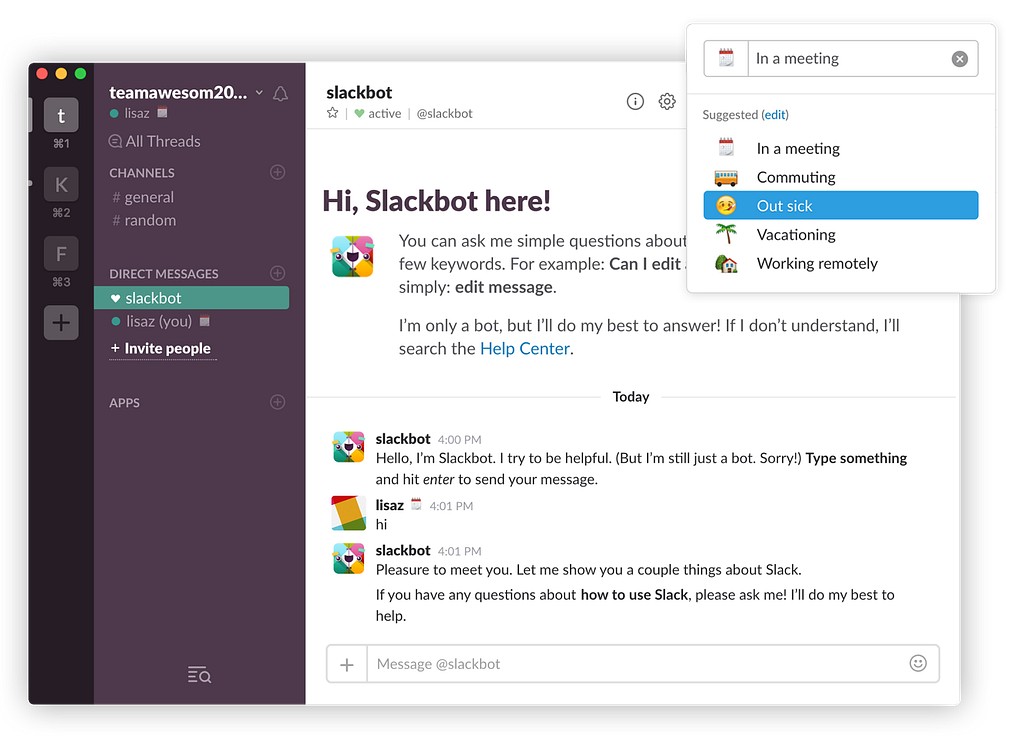
Slack has been called the fastest growing workplace software ever, by The Verge. But its functionality did not vary much from its competitor Hipchat, according to Andrew Wilkinson, the founder of Metalab, which designed the original Slack.

The difference lies within emotional design. Slack looks very different from its competitors which makes it stand out. Its round shapes, vibrant colors, friendly typeface and emojis make it more reminiscent of a computer game than the typical blue-grey enterprise software. But it doesn’t just look different, it also feels different — the animations give the impression that the app is playfully jumping around. When the logo is loading for example, it bursts into colors like a confetti explosion. “When you hear people talk about Slack, they often say it’s ‘fun,” Andrew wrote on Medium.

Personality and Humor

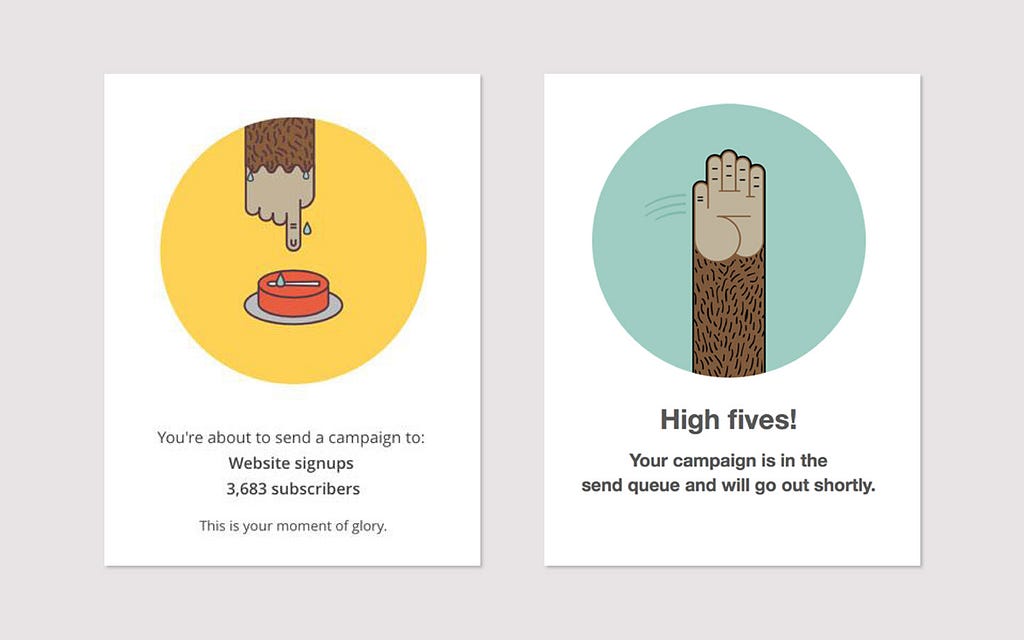
We like interacting with humans more than machines, so adding personality to our products helps users build a bond with them. For example, Mailchimp lets its personality shine through in the smallest details, from the copy on its front page to the graphics users receive as they send out email blasts. Its tone of voice is familiar, friendly, and funny, like an actual person and not a faceless bot. The voice of Mailchimp tells jokes and stories and talks to its users like a good old friend:

Users loved this so much, they’ve even tweeted about their experience when sending a campaign through Mailchimp.

Reward
Neuroscientists have found that dopamine is released in anticipation of a reward. It’s this positive rush of emotions that keep us repeating certain behaviors and can even lead to addictions. Instagram for example uses rewards very effectively. Users obsessively check their feed, because they’re hoping for likes on their last post, which would make them feel good.

Variable Surprise
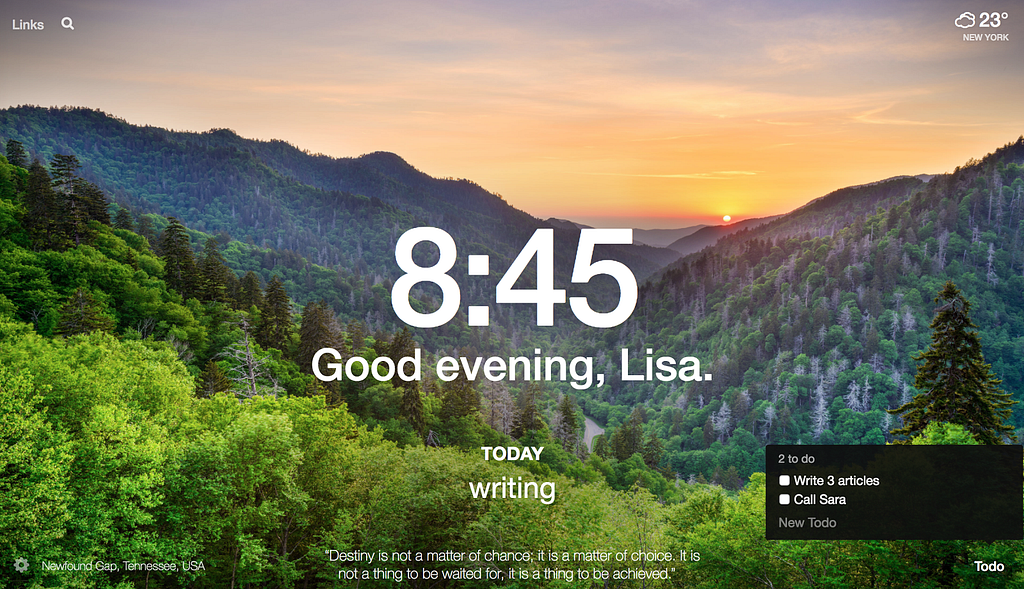
The Google Chrome Plugin “Momentum” surprises its users every day with a different quote and background image from a beautiful destination. Users expect variability, but the exact image and quote is a mystery until it’s revealed, so each morning it’s a delightful experience. I’ve even tweeted it’s quote several times, and recommended the product to friends.

The overlooked business value
When it comes to digital product design many companies still focus on simply making their products functional and usable. Why? Working as a digital Product Designer, I realized that in the hectic world of product development, we often feel pressure to ship new features fast and push delightful elements to “later” (which often means never). As a result, companies end up spending more money on advertising to compensate for users who are not returning or not talking about their product.

In my own experience, product teams are often simply not aware or underestimate the business value of emotional design.
It can actually help to meet important business goals such as increasing conversion and sales. It even has the power to make users forgive the shortcomings of a product.

For instance, in his book Emotional Design, Don Norman writes about the business value of emotional design:

“Apple Computer found that when it introduced the colorful iMac computer, sales boomed, even though those fancy cabinets contained the same hardware and software as Apple’s other models, ones that were not selling particularly well.

And in Aaron Walter’s book Designing for Emotion, he reports on how Blue Sky Resumes (a service that helps people create resumes) saw a 65% increase in clients each month and a 85% increase in total revenues, by changing nothing but their design.

While emotional design alone does not make a product great, it has the power to inspire strong feelings in users, emotions which equate in high rates of retention and positive word-of-mouth. It’s a powerful growth hack that any company should take advantage of, and in today’s competitive market it’s becoming an essential element of success.


The most overlooked growth hack: designing for emotions was originally published in uxdesign.cc on Medium, where people are continuing the conversation by highlighting and responding to this story.

from uxdesign.cc – Medium https://uxdesign.cc/the-most-overlooked-growth-hack-designing-for-emotions-1a3ba503d4f4?source=rss—-138adf9c44c—4

The truth no one will tell you about moving to a new country


The truths no one will tell you about moving to a new country

Seven years ago I was catching a flight to what I thought was going to be “just a temporary gig in another country”. Sure.

Photo: Paul Kim

September 2010. After being “found” on Linkedin by a foreign recruiter and accepting a job offer in the US, I was catching a flight to what I thought was going to be “just a temporary work experience”. What started as a career decision ended up being one of the most transformative experiences in my life. Here are a few things I have learned along the way.

  • You are not as fluent in English as you think you are. Nobody out in the real world speaks at the pace and with the patience of an English-as-second-language teacher. You will likely have to study the new language a thousand times more once you make the move.
  • There’s no such thing as losing your accent. The more you lose your accent when speaking, the better your ears will get at recognizing accents — including your own. Get over it.
  • You are not going to be the same person you were in your native language. You can’t. Your personality (the one you are so proud of in your mid twenties) will not survive in a foreign culture. You’ll have to find your new self, your new vocabulary, your new behaviors, your new tone of voice, your new jokes, your new social interactions — or you will always feel like a fish out of water. Unless you have zero self-awareness, in which case you’ll be just fine.
  • You are going to spend a few nights thinking you made the wrong decision. You will cry, but you won’t tell anyone (well, maybe 7 years later…). This will probably be the best endurance test you will go through in life. Do you want it, or do you not want it that much?
  • You will learn you can live an entire life without possessing things. Sharing economy + free spirit + investing your money in the right places. Choosing this path will transform your relationship with the world in many, many levels. You will stop spending emotional energy in desiring to own things and in showing the world you own them.
  • When you are free to wear, pray, worship, eat, look and behave the way you want, you are more likely to follow rules and obey the law.
  • You will learn to “run a ballpark estimate”, “set up a touch base with the team”, “make sure you cover all the bases” and learn how to “handle curveballs right off the bat”. When you’re born in the nation of soccer, reading expressions like these can be disorienting; it’s what I like to call “Baseball English”. After a couple years living and breathing the American culture, you will learn to understand, appreciate, and respect each of these expressions.
  • You will meet people from countries and cities you have never heard of, and you will find it shocking how homogeneous your own country is. Your first reaction will be to try to bucket people into categories (“French people are more straightforward”, “Canadians are nicer”), but that won’t last long. The more you get to know individuals, the more you’ll realize they are quite unique. You will understand that culture ≠ personality, and you’ll be fascinated by how many combinations you get when you mix both.
  • Some people in the country you’re moving to have no idea about the rest of the world (e.g. some Americans do believe that the USA is the only free country in the world). Your first reaction will be to think they are silly. Only until you realize how many things you didn’t know about their country either, and you’ll stop thinking in terms of “us” vs. “them”.
  • The fact you are a foreigner is not as interesting as you think. When you move to a new country, all you want to talk about to your new friends is how “things are different back home, let me tell you”. After a few years you’ll realize this is boring for everyone, including yourself. It makes for good small talk, but doesn’t get you to deeper, more relevant conversations.
  • There’s a chance you will not understand TV humor in America. In my case, I did not understand TV humor back home either — so no drama here.
  • Every country is culturally huge, regardless of its territory or population. The same way you are going to hate when people paint your country’s culture in broad strokes, you will have to learn to use thinner brushes yourself. You can’t have it only one-way. It’s not fair.
  • The feeling of security you get as you walk on the streets (compared to your hometown) can slowly kill your animal instincts of awareness, self-defense, survival. Find other ways to not let them die.
  • You will have issues defining your own ethnicity, simply because classification models vary quite a lot from country to country. Don’t take it personally.
  • You will have to learn to measure the world under new lenses: Fahrenheits, miles, pounds, inches, tip percentages. If you like brain puzzles and appreciate the value they add to your cognitive abilities, you’ll be fine. Also, Google is your friend.
  • Moving to a new country is opting in for a journey that will be painful, delightful, unexpected, harsh at times — but above all, transformative. It will force you to deconstruct your so-perfect self, and to build empathy with an entire nation, which is one of the most aggrandizing experiences one can go through in life. Embrace it.
  • Wherever you are, there you are.

from Stories by Fabricio Teixeira on Medium https://medium.com/@fabriciot/the-truth-no-one-will-tell-you-about-moving-to-a-new-country-53ee52a9867d?source=rss-50e39baefa55——2

This is what 500 years of graphic design in print looks like


This is what 500 years of graphic design in print looks like

A new book from Phaidon chronicles the history of printed imagery

Wozzeck, poster, Jan Lenica, 1964, Warsaw Opera, Poland.

In 1455, the budding Italian urbanist and author Enea Silvio Bartolomeo Piccolomini was in Frankfurt viewing a first edition of the Gutenberg Bible. Later he gushed in a letter to Cardinal Juan Carvajal, “The script was very neat and legible, not at all difficult to follow — your grace would be able to read it without effort, and indeed without glasses.” Enea, who was three years off from being ordained Pope Pius II, was already well on his way to Holiness that day. But his epiphany with the printed page almost certainly helped shape the pontiff-to-be’s ambition in letters: Pius’ novel The Tale of Two Lovers would become a 15th century bestseller and remains in print to this day.

Gutenberg’s accomplishment—the first major book printed with mass-produced, moveable type—was a watershed in the advancement of information distribution. It was also the European impetus for what we now call graphic design.

The Gutenberg Bible, book, Johannes Gutenberg, c.1453 to 1455, self- commissioned, Germany (page 469).

A new book published by Phaidon, Graphic: 500 Designs that Matter, collects milestones from the rich history of visual communication into a single tome of pioneering design and typology. Pairing canonical works to emphasize visual echoes across the ages, Graphic draws connections between images as disparate as the Nazi swastika (1920) and original Macintosh alert icons (1984). The result is a bold, non-chronological litany of some of the most important visual messaging of the past thousand years. Think Fette Fraktur meets the Nike “swoosh” logo.

In a world inundated with information, graphic design—the way in which messages are communicated through media—is vitally important. From subway maps to pie charts, great design cuts through the clutter to help shape and direct daily experience, either by facilitating our ability to quickly absorb what we need to know, or forcing us to question the obvious. Now if only the internet would catch up.

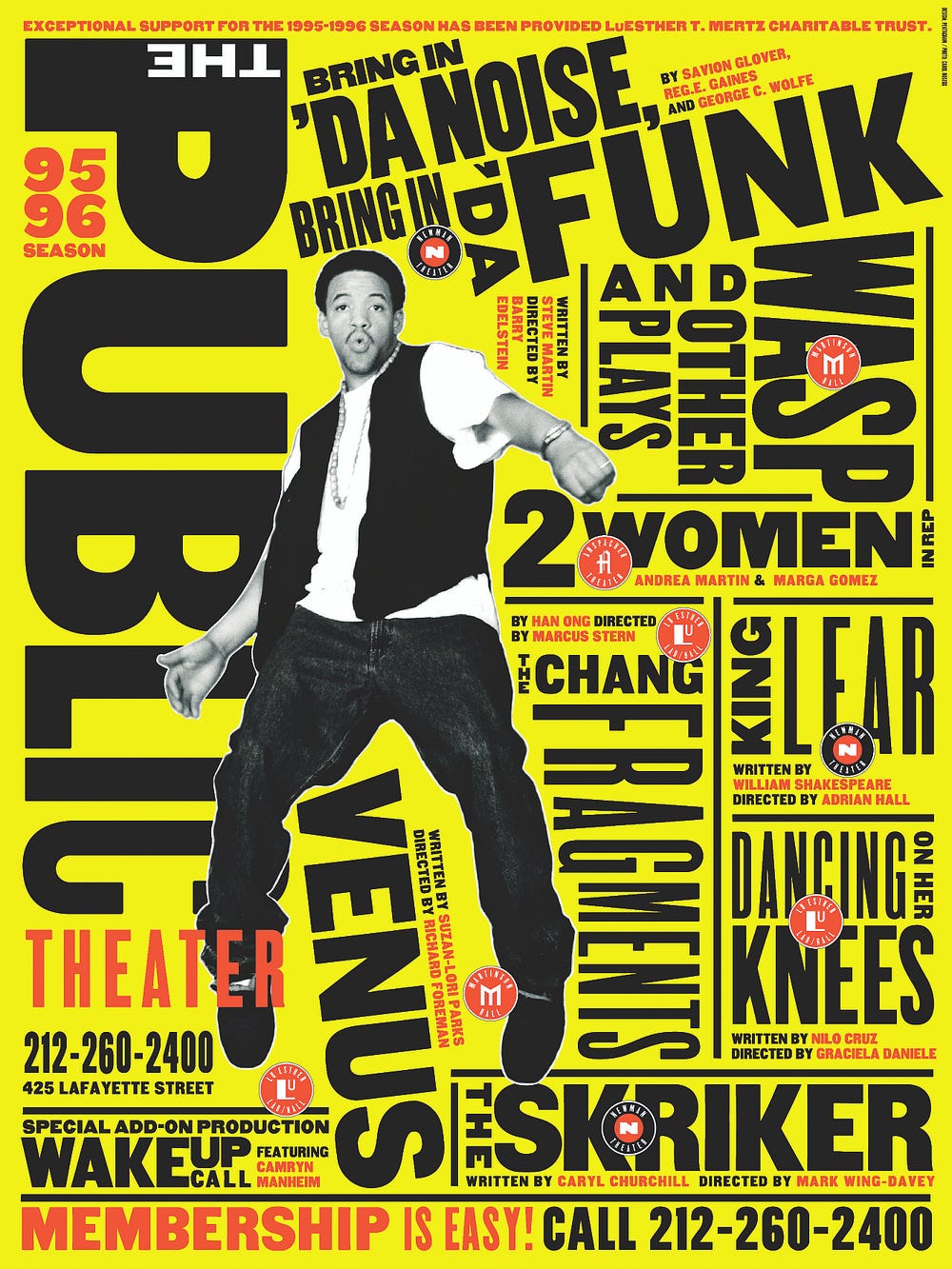
Public Theater, poster, Paula Scher, 1995, Public Theater, US: ‘Bring in ’Da Noise, Bring in ’Da Funk’, Public Theater poster, 1995.

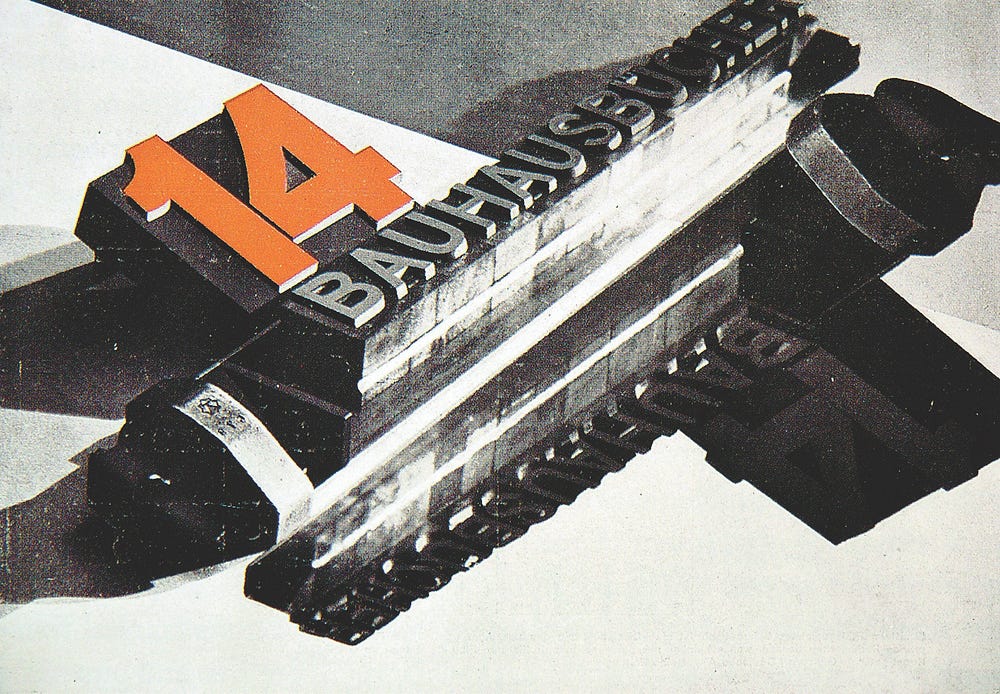
Bauhaus programmes, book, László Moholy-Nagy, Herbert Bayer, Walter Gropius, 1922 to 1931, Bauhaus, Germany: Bauhausbücher 14 by László Moholy-Nagy, 1929.

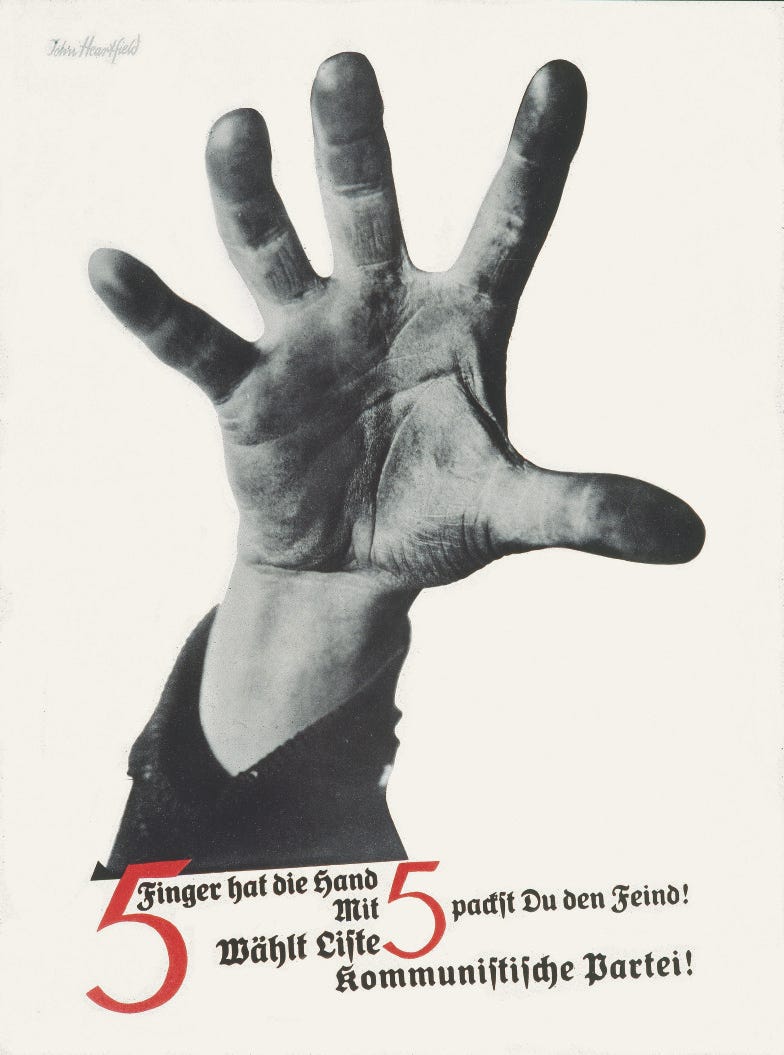
(left) 5 Finger Hat Die Hand, poster, John Heartfield, 1928, German Communist Party, Germany: Die Rote Fahne, 13 May 1928. | (right) Vanity Fair, magazine cover, Mehemed Fehmy Agha, 1929 to 1936, Condé Nast Publications, US / Vanity Fair, cover illustration by Jean Carlu, art direction by Mehemed Fehmy Agha, April 1931.

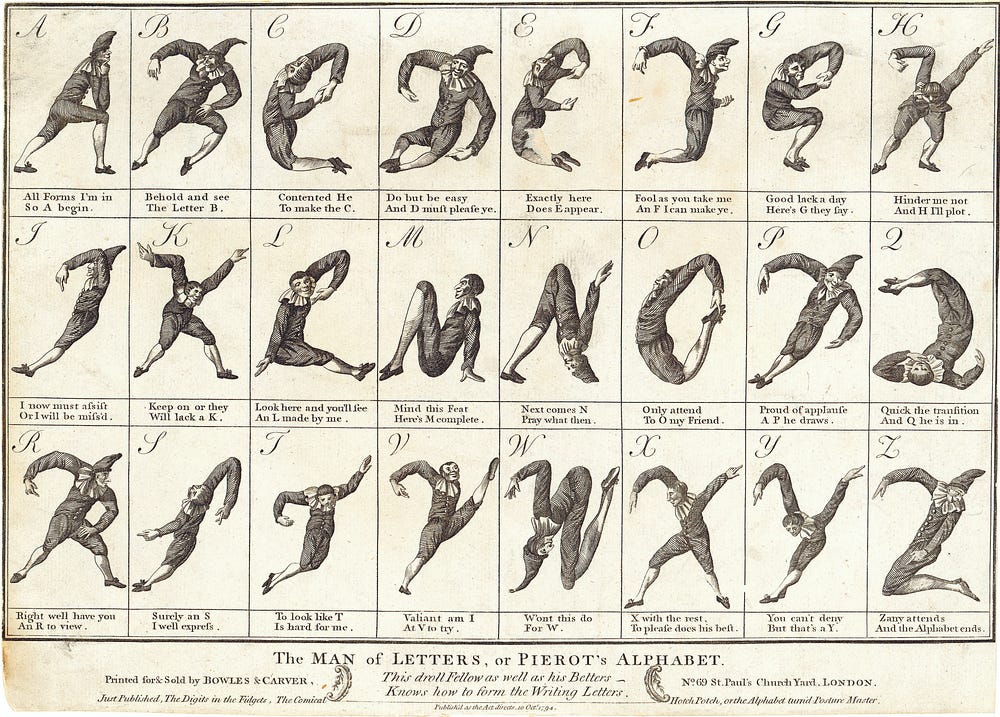
The Man of Letters, or Pierrot’s Alphabet, typeface, (designer unknown), 1794, Bowles & Carver, UK.

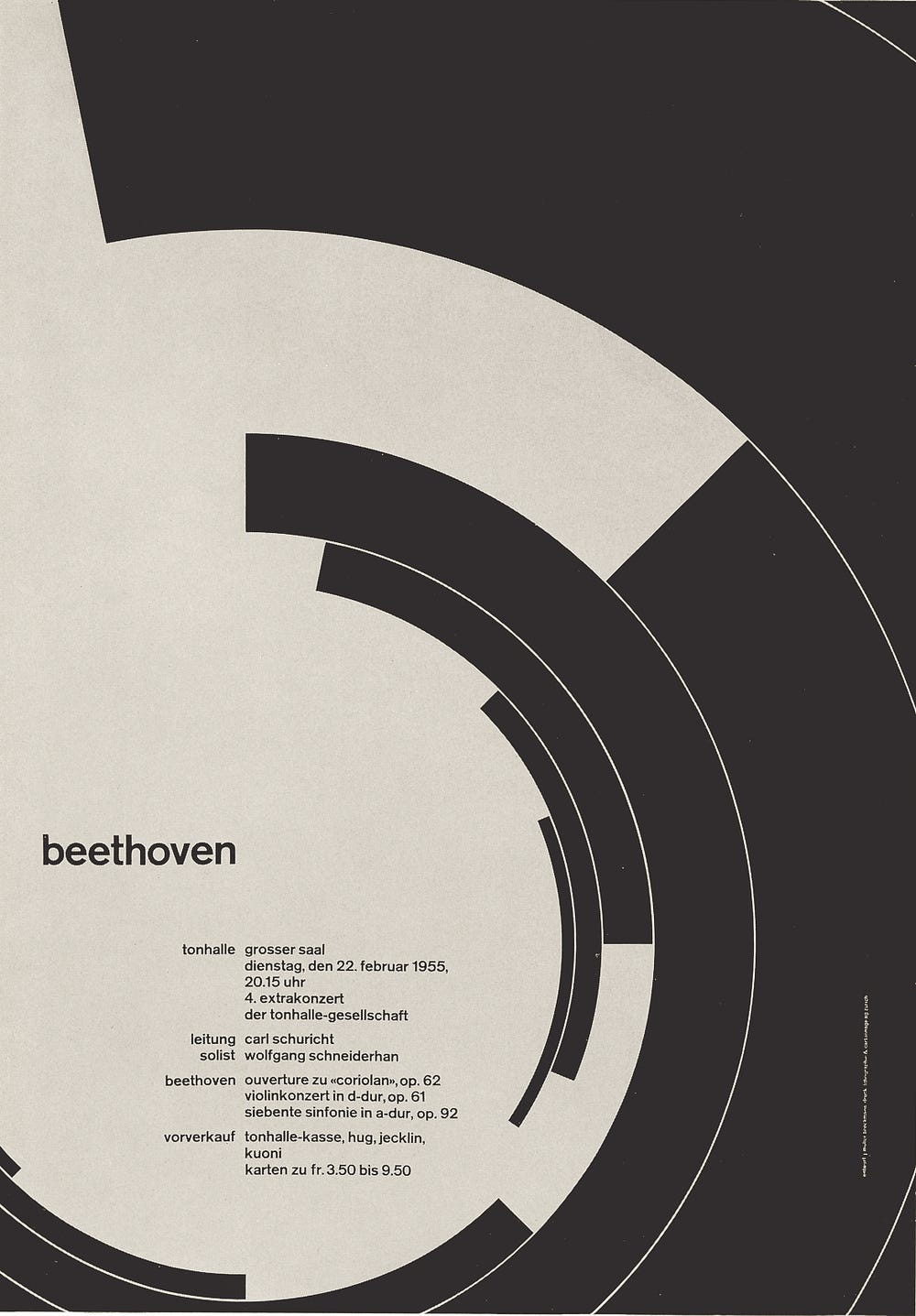
(left) Othello, poster, Gunter Rambow, 1999, Hessisches Staatstheater, Germany. | (right) Beethoven, poster, Josef Müller-Brockmann, 1955, Tonhalle Zürich, Switzerland; image courtesy: © Josef Müller-Brockmann Archive.

IBM, 1956–1991, identity, Paul Rand, IBM, U.S.

Nippon, magazine cover, Nihon Kobo [Japan Studio], 1934 to 1944, self- commissioned, Japan; image courtesy: Fukushima Prefectural Museum of Art © Miwa Natori: Nippon, design Ayao Yamana, photograph Yoshio Watanabe, 1934.

Luchshih Sosok ne Bilo i Nyet, poster, Aleksandr Rodchenko, 1923, Rezinotrest, Russia.


Graphic: 500 Designs that Matter is published by Phaidon. All images courtesy the publisher.

from Sidebar https://sidebar.io/out?url=https%3A%2F%2Ftimeline.com%2Fthis-is-what-500-years-of-graphic-design-in-print-looks-like-53d413e56987

Levi’s New Chatbot Helps Online Shoppers Find Jeans

Levi Strauss & Co. has joined a wave of companies developing new digital interfaces based upon the fusion of messaging and machine learning. Levi announced Thursday the release of its artificially intelligent Virtual Stylist, which converses with online shoppers to offer jean recommendations based on style preferences and fit, similar to the the way a […]

from CIO Journal. https://blogs.wsj.com/cio/2017/08/31/levis-new-chatbot-helps-online-shoppers-find-jeans/?mod=WSJBlog

See how Bank of America + IDEO applied design thinking to create an empathetic solution to savings

What would you do if you were tasked with inspiring people to open bank accounts? In 2004, Bank of America gave this same challenge to design firm IDEO—and a human-centered, ethnographic-based approach led to the solution, a campaign called “Keep The Change.”

After making observations across the country, the IDEO team realized several people in charge of household finances were intentionally fudging their math. That is—they were rounding up to make addition easier, which also added a buffer in their bank accounts.

Read: The full “Keep The Change” case study on DesignBetter.Co

This was something IDEO could really use. Instead of starting inside the walls of Bank of America headquarters with marketing tactics and assumptions, IDEO ventured into the field to observe real people’s relationships with money.

IDEO’s final solution became a huge business success for Bank of America, but it also created a change in mental state for customers. And that is why empathy is so crucial to design thinking.

“More than a methodology or framework, design thinking combines the problem-solving roots of design with deep empathy for the user.” —Eli Woolery, DesignBetter.Co

Guiding your own team to practice empathy is the surest way to create a relevant product that’s functional and delightful to use. To help people practice empathy, Stanford’s d.school created a challenge called The Wallet Project.

This project tasks participants with designing a wallet in just a few minutes. After they’ve sketched use cases and specifics, the participants are directed to interview someone specific. Following this conversation, they’re again directed to design a wallet—but for the specific individual instead.

As you can imagine, versions 1 and 2 of those wallets will look quite different. This simple exercise is a powerful way to demonstrate empathy’s effect on design.

We adapted this exercise so you can use it with your own team. The scope has been pared down, so it fits well within a 15-minute time block. In the interview portion, we also suggest a few specific questions elicit feedback that has the potential to truly influence your designs.

After you give this exercise a go, imagine how you could apply the practice to your work.

For expert insights and suggestions—or to learn more about IDEO and Bank of America’s “Keep the Change” campaign—check out the Design Thinking Handbook on DesignBetter.Co.

More posts on empathy and product design:

from InVision Blog https://www.invisionapp.com/blog/applied-design-thinking/

AI is not optional for retail

Most people don’t realize that they’re likely exposed to AI each and every time they shop online — whether it’s on eBay, Nordstrom.com, Warby Parker, or any other retailer. When you are searching for an item and a merchandising strip appears saying something like “similar items” — that’s AI in its simplest terms. It’s what gives retailers the ability to automatically make informed recommendations.

AI has been around for many years, but recent advancements have moved AI out of the realm of science fiction and made it a business imperative. The game changers: powerful new GPUs, dedicated hardware, new algorithms, and platforms for deep learning. These enable massive data inputs to be calculated quickly and made actionable, as technology powers new algorithms that dramatically increase the speed and depth of learning. In mere seconds, deep learning can reach across billions of data points with thousands of signals and dozens of layers.

We all aspire to a grand vision of AI’s role in commerce, and recent developments are creating a fertile environment for new forms of personalization to occur between brands and consumers. Make no mistake about it, the implications of AI will be profound. This is the new frontier of commerce.

A multimodal, multi-platform approach

As an industry, we are just beginning to scratch the surface of AI. In the next few years, we will see AI-powered shopping assistants embedded across a wide variety of devices and platforms. Shopping occasions will take advantage of camera, voice interfaces, and text.

We are already witnessing the early success of voice-activated assistants like Google Home, Siri, and Cortana. It won’t be long before we see virtual and augmented reality platforms commercialized, as well. We see a future rich with voice-activated and social media assistants on platforms such as Messenger, WeChat, WhatsApp, and Instagram. Personal assistants will be everywhere and are already being woven into the fabric of everyday life. This means commerce will become present wherever and whenever the user is engaged on the social, messaging, camera, or voice-activated platforms of their choice.

AI: The future is personal

AI by itself is simply a catalyst for achieving greater levels of personalization with shoppers. Customer data and human intelligence are the critical ingredients needed to run a personal AI engine. As we continue to launch more sophisticated applications, technologists should continue to focus on how to make greater use of our treasure trove of customer data. Looking ahead, the industry will evolve to combine customer data and human expertise into a deep knowledge graph. This will establish a knowledge base to create highly personal and contextual experiences for consumers. For the commerce industry, this will allow us to get a clearer understanding of shoppers’ intent and to service them in a more personalized way.

Personal commerce

Keyword search for shopping is not enough anymore. The ability to use text, voice, and photos is becoming the new norm because these avenues provide users with a much richer and more efficient way to express their initial shopping intent. We call this “multimodal shopping.” And these new types of consumer interactions yield a tremendous amount of user data that can be poured right back into AI algorithms to improve contextual understanding, predictive modeling, and deep learning.

Across the three spectrums of multimodal AI, we’re starting to get much better at understanding our customers and the way they like to interact with us. A few good examples of this have to do with how our personal shopping assistant, eBay ShopBot on Facebook Messenger, “remembers” you. It can keep track of your shirt size or the brands you like, so it won’t keep suggesting Nike when you prefer Adidas. The assistant also uses computer vision — it can find similar products it knows you like based on a similar image or an exact photo match.

Innovating on a canvas of AI provides many new opportunities to create highly contextual and personalized shopping experiences. From our perspective, every company should be investing heavily in AI, and it shouldn’t just be about using cognitive services. Companies should actually be developing their own models that keep them on the cutting edge of technology. While there is still a lot of work to be done in this area, one thing is clear. The companies that chart the right course in this exciting endeavor will prosper. The ones that don’t face extinction.

Japjit Tulsi is the VP of Engineering at eBay.

from VentureBeat https://venturebeat.com/2017/08/13/ai-is-not-optional-for-retail/

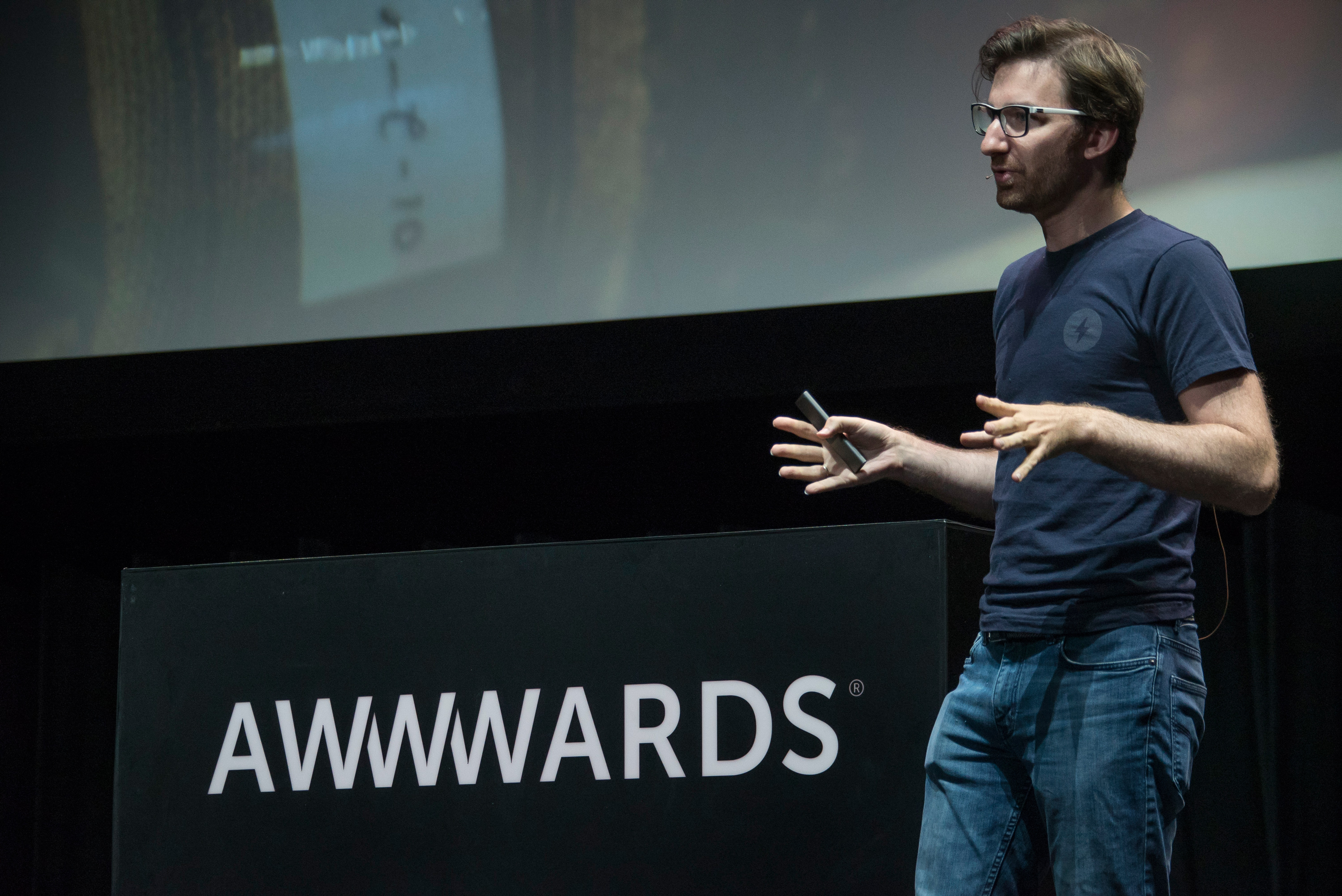
Paul Bakaus from Google: The Illusion of Speed – Improving the Perceived Speed of Websites.

Paul Bakaus, Developer Advocate at Google who heads up outreach for AMP, DevTools and Games, explains why perceived performance matters much more than actual performance – delving into the perceived performance theory, Paul shares examples of how employing clever tricks and psychology can turn things that should be slow into things that feel incredibly fast.

On average people in passive wait mode overestimate their waiting time by about 36%

Get your free eBook!

Want to know more? Do not miss our eBook made in collaboration with Google and industry experts: Brain Food: Speed Matters – Designing for Mobile Performance, where you can find tons of TIPS and tricks to help you optimise your mobile websites to the highest level. Download your free copy here!

To keep up to date with the latest from Paul, follow him on twitter @pbakaus

Don’t miss out, BE THERE! Get your tickets for valuable networking with top web design agencies and learning first-hand the latest trends from thought leaders – next stop Awwwards Berlin!

from Awwwards – Blog https://www.awwwards.com/paul-bakaus-from-google-the-illusion-of-speed-improving-the-perceived-speed-of-websites.html

Tesla’s ‘tiny house’ hits the road in Australia to show off solar power potential

Tesla has a new way to demonstrate the possibilities of its home solar products to potential customers – using a ‘tiny house’ on wheels, which it can tow on a rolling tour with a Tesla Model X. The Tesla Tiny House made its official debut in Australia (via Electrek), where it will welcome visitors at Melbourne’s Federation Square, before taking off for a cross-country Australian tour.

The towable Tiny House is reminiscent of the mobile design studio it introduced last September, which was a reconfigured Airstream that let people build their own Tesla vehicle as a kind of mobile virtual studio. These solar-focused demonstration trailers also feature mobile design studios and configurators within, but for Tesla’s solar products, including solar panels and its Powerball energy storage battery for the home.

The Tiny House has actual siding this time around, which is made up of sustainable timber with not artificial chemical treatments. It weighs 2 tonnes (around 4,400 pounds) and has 2kW solar generation capacity using 6 panels, which can feed the single Powerwall battery mounted on the side.


Tesla’s touring the country with destinations at ever major Australian city, but residents can also request it swing by and pay a visit to smaller towns along the way, too. Tesla doesn’t yet offer solar installations in Australia, but it clearly wants to prime the pump, and it does sell Powerwall batteries for use with solar installations from other providers.

This model seems likely to be applied to other markets, too, should the Tiny House prove effective in swaying Australian customers. On the commercial side, Tesla is also building a huge renewable power storage facility using its Powerpack batteries, which will be the largest such facility in the world once it’s complete.

from TechCrunch https://techcrunch.com/2017/08/14/teslas-tiny-house-hits-the-road-in-australia-to-show-off-solar-power-potential/?ncid=rss